- Author: 謝孟恭
- Publisher: 天下文化
- Publication Date: April 20, 2021
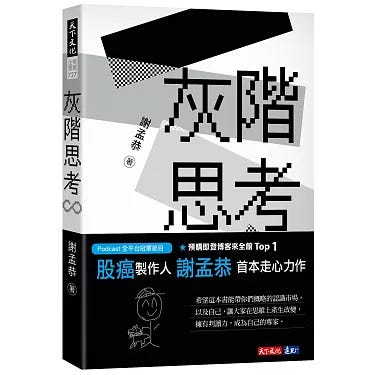
In this age of information overload, we are often trapped in oversimplified binary thinking: Should we go all-in on Tesla? Should we hold Bitcoin exclusively? Will the market surge or crash? However, through Meng-Kung Hsieh’s “Gray Scale Thinking,” I discovered a more intelligent approach to investment thinking.
Investment Is a Journey of Self-Discovery
What resonated with me most was the book’s assertion that there are several ways to understand yourself, and your account statement serves as an investor’s “manual.” This made me realize that investing isn’t just about managing money; it’s about managing ourselves. Our reactions to market volatility often reflect our truest selves.
Hsieh suggests that beginners start with a portfolio allocation of 70% passive ETF investment and 30% active stock picking. This is a well-balanced recommendation that maintains a safety margin while giving investors room to explore and learn. It reminds me of Warren Buffett’s famous quote: “Diversification is protection against ignorance” — indeed, moderate diversification is wise before we fully understand ourselves.
The Art of Optimism, Patience, and Risk-Taking
The book highlights three crucial virtues of successful investors: optimism, patience, and risk-taking. This particularly struck a chord with me. As the author notes, optimism isn’t blind confidence but rather “having eyes that foresee the future and feet that move forward steadily.” This kind of optimism is built on solid research and deep insights.
Patience might be the virtue most lacking in modern investors. Under the bombardment of real-time information, we’re easily tempted by short-term trading. The author points out how dangerous it is to “learn a little today and go all-in tomorrow” — such forced growth only hinders the accumulation of experience and compound returns.
Building a Personal Investment Methodology
What impressed me was the author’s emphasis on reading. He particularly stresses the importance of reading prototype knowledge as fundamental training for developing judgment. Investment isn’t an exam with standard answers, but through extensive reading, we can build our own judgment system.
The author reminds us to pay special attention to Guidance and Catalysts when researching companies, which are key focus areas for professional investors. More importantly, he reminds us: “The key often isn’t what we see, but what we don’t see.” This reflective thinking approach is crucial in helping us avoid investment pitfalls.
Conclusion: Finding Wisdom in the Gray Areas
The greatest value of “Gray Scale Thinking” lies in helping readers break free from binary thinking frameworks. The investment world is full of uncertainties, and what we need isn’t perfect answers but rather building an investment system that suits us. As reflected in the author’s three investment principles: avoid heavy positions, enter positions gradually, and admit mistakes when wrong — these all embody the wisdom of maintaining flexibility amid uncertainty.
Investment is a lifelong learning journey, and “Gray Scale Thinking” is not just an investment guide but a book that teaches us how to think in a complex world. As Einstein said, the only thing that interferes with learning is education — perhaps we all need to occasionally break free from existing frameworks and seek new possibilities in the gray areas.