A practical guide to harmonic distortion analysis using a free browser-based tool
Back-EMF (Back Electromotive Force) is the voltage generated by a spinning motor. Analysing its harmonic content reveals critical information about motor quality, winding symmetry, and potential electromagnetic interference. Total Harmonic Distortion (THD) is the standard metric used to quantify this distortion.
This guide walks through the complete process — from capturing the waveform to obtaining a reliable THD value — using a free, browser-based FFT analyser that requires no software installation.
1 Capture the Back-EMF Waveform
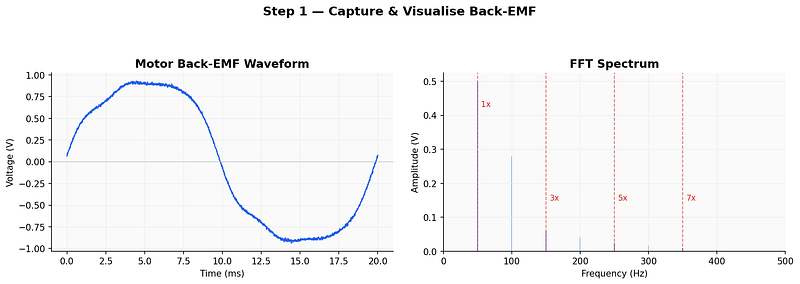 A real motor back-EMF contains a fundamental plus harmonics. The FFT spectrum on the right reveals each harmonic component.
Equipment needed
- Oscilloscope (any brand that exports CSV)
- Motor under test — spin at constant RPM
- Differential probe or voltage divider if voltage is high
Measurement tips
- Spin the motor at a stable, constant speed — THD changes with RPM
- Capture at least 5–10 complete cycles for better frequency resolution
- Use a sampling rate at least 10× higher than the highest harmonic you want to measure
- Export as CSV from your oscilloscope software
Tektronix CSV format:
  Column D = Time (seconds)
  Column E = Voltage (V)
2 Understand FFT Bins and Spectral Leakage
Before running FFT, two key concepts determine the accuracy of your results.
What is an FFT Bin?
FFT divides the frequency range into fixed-width slots called bins. Think of them as buckets — each bucket collects energy from a specific frequency range. The bin width is determined by:
Bin width (Hz) = Sampling rate / Number of points

Example: 250,000 Hz ÷ 16,384 pts ≈ 15.3 Hz per bin
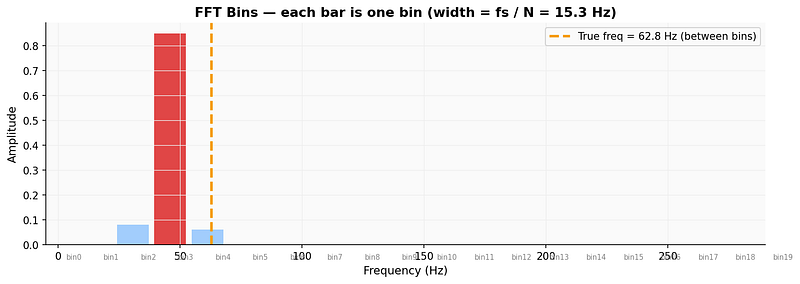 Each bar is one FFT bin. When the true frequency (yellow dashed line) falls between bins, energy spills into neighbouring bins — this is spectral leakage.
The problem: A motor’s fundamental frequency almost never aligns perfectly with an FFT bin. Energy between bins spreads into neighbours, creating false harmonics and inaccurate THD readings.
3 Choose the Right Window Function
A window function solves the leakage problem by multiplying each sample by a weight that tapers smoothly to zero at both ends. This eliminates the boundary discontinuity that causes leakage.
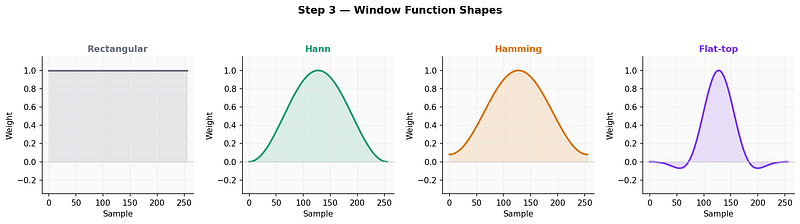 All window functions taper the signal edges. The key difference is the trade-off between frequency resolution and amplitude accuracy.
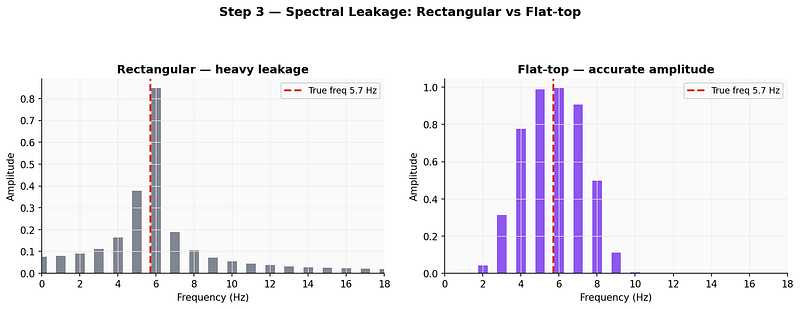 Left: Rectangular window shows heavy leakage — energy spreads across many bins. Right: Flat-top window keeps the peak amplitude accurate even when the frequency is between bins.
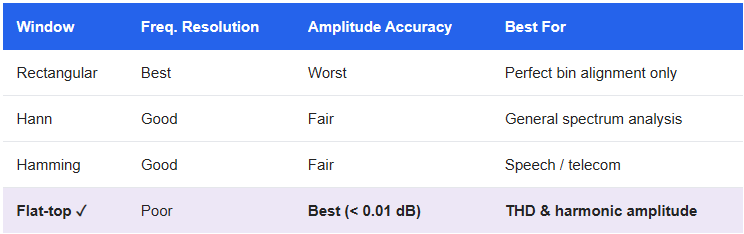
For back-EMF THD measurement, always use Flat-top window. It provides the best amplitude accuracy regardless of bin alignment — which is almost never perfect in real measurements.
4 Run the FFT Analysis
Option A — Upload CSV
- Click the Upload CSV tab
- Drag and drop your oscilloscope CSV file
- Select Flat-top window function
- Click Analyse
Option B — Paste data directly
- Click the Paste Data tab
- Copy two columns (time + voltage) from your spreadsheet
- Paste into the text area — sampling rate is auto-detected from the time column
- Select Flat-top and click Analyse
5 Interpret the Results
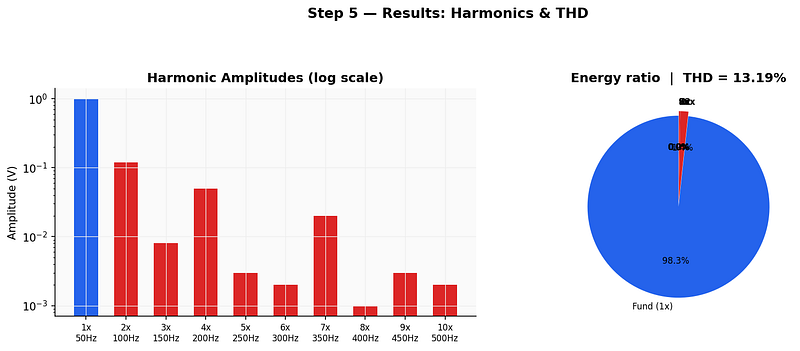 Left: harmonic amplitudes on log scale — a healthy motor shows rapidly decreasing harmonics. Right: energy ratio pie chart with THD percentage.
Fundamental frequency (1x)
The tool automatically identifies the largest peak as the fundamental. A 4-pole motor at 3000 RPM produces a fundamental around 100 Hz.
Harmonic amplitudes (2x–10x)
The bar chart uses a logarithmic scale so you can see all harmonics simultaneously. In a healthy motor, harmonics should decrease rapidly. Prominent odd harmonics (3x, 5x, 7x) often indicate winding asymmetry.
THD calculation
THD = √(A₂² + A₃² + ... + A₁₀²) / A₁ × 100%

Where A₁ = fundamental amplitude
      A₂–A₁₀ = harmonic amplitudes
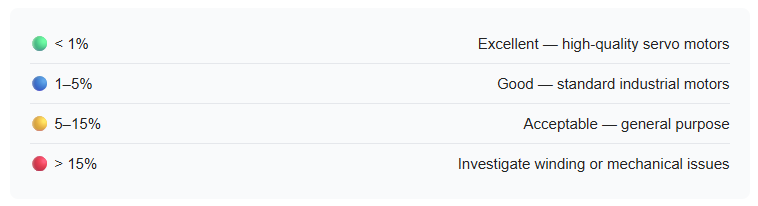
Typical THD ranges for motors
6 Export and Document
Click Export CSV to download the full spectrum and harmonic summary. The file includes frequency and amplitude for every FFT bin, the complete harmonic table, and the THD value — ready to attach to your test report.
Common Pitfalls
- Using Rectangular window: Only accurate when signal frequency perfectly aligns with a bin — almost never the case in real measurements.
- Too few cycles: Less than 5 cycles reduces frequency resolution. More cycles = narrower bins = better harmonic separation.
- Comparing across RPM: THD is RPM-dependent. Always document motor speed alongside THD value.
- Large DC offset: The tool removes DC automatically, but a large offset can reduce measurement dynamic range.
Summary
Back-EMF THD analysis comes down to three decisions:
- Capture enough cycles — at least 5–10 for reliable frequency resolution
- Use Flat-top window — for accurate harmonic amplitude measurement
- Understand bin misalignment is normal — window functions handle it
The free tool below automates all FFT computation so you can focus on interpreting the motor’s health from the harmonic spectrum.